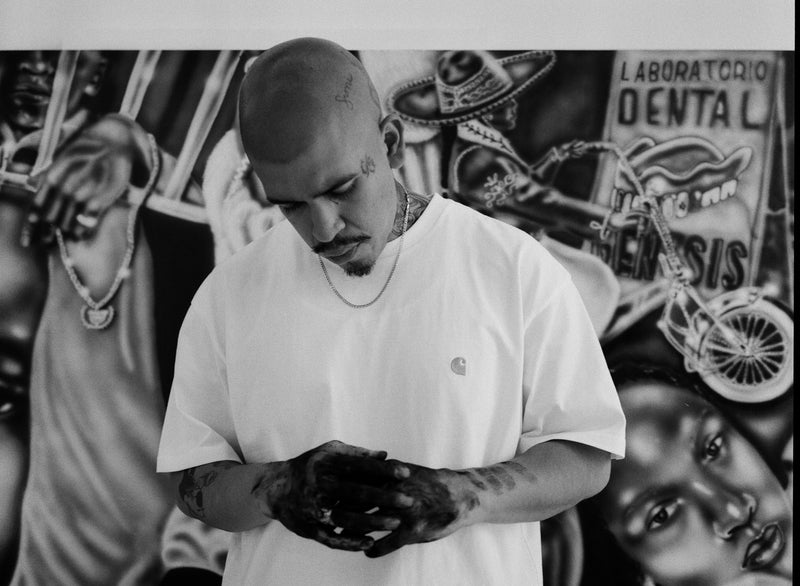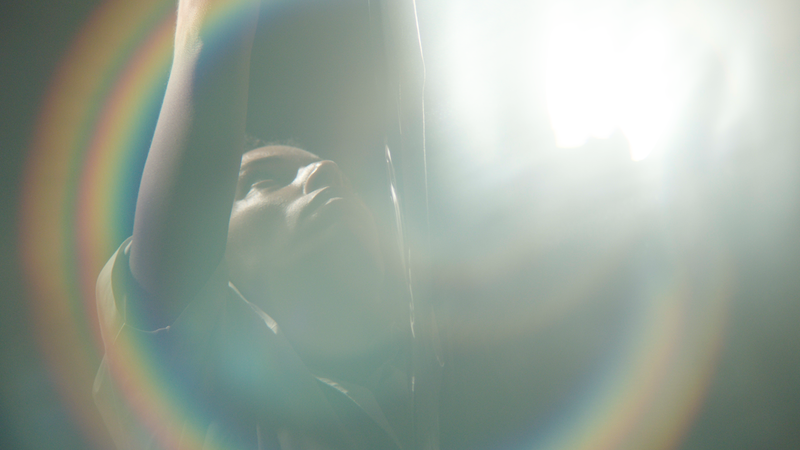
Garrett Bradley for Patta Magazine
Garrett Bradley for Patta Magazine
Known for her artistic use of visuals across documentary, short films, feature films, installations, and beyond, filmmaker and director Garret Bradley uses her work to ask questions about everyday life, often revealing intimate answers in doing so. Sociopolitical in nature, Bradley’s oeuvre spans early works like America and her Oscar-nominated feature Time, and is often intrinsically tied to the Black experience, exploring and elevating those narratives into rich and multifaceted stories. Below, Bradley, who had a major exhibition at the Eye Filmmuseum in Amsterdam last summer called Revolutions, reflects on transparency, the weight of her visuals, and the responsibility of bringing Black life to the screen.In Time, and throughout your broader body of work, you render the political through intimacy, the social through the personal. How do you think about the ethical dimensions of that gesture?Whether it’s in resistance to, or in harmony with, even the most intimate choices we make are connected to the bigger picture. And anything that's made: a book, a movie, a choice, operates the same way. Transparency is an anchor point of anything ethical. Being transparent about what I know, and what I don't know…what my intentions are, my opinions even….Being clear includes people within a line of logic that isn't a secret, that can be agreed or disagreed with from an informed, even autonomous place, and I think that’s an integral part of making films about people and with people…And sometimes you know, when you’re working in a quieter space, that doesn't require anyone else, there is still an important dialogue happening. It’s like a mantra at this point that images are belief systems and that responsibility is one that has to be taken seriously. I’m not saying that anyone has to have clarity of what they're making. Or even a sense of purpose. You don't have to have a message or even be interested in one. Creating in an unknown space and moving through doubt are part of what makes making things so magical and deeply human. I think what I’m saying is that the purpose of anything you make and its meaning will be made for you eventually by anyone who encounters it. And anything that reaches the world, or even just as its maker, even if no one sees it, creates a ripple effect and influence that ranges in subtlety. I think about that a lot. It might even be the place that I’m always starting from, the ethical dimension. In a moment when images of suffering are so easily consumed, what does it mean to make work that insists on care, duration, and presence?I don't know if I believe that any images of suffering are easily consumed. It might appear that way, but our subconscious informs the way we feel and act and see the world much more than we think.On one hand, the conscious act of taking my time is out of my control. It’s just the way it is, what the work and the process demands. And there’s so much being made on a regular basis, the world doesn't need me or any of us to output at the same rate. I like thinking about each of those words, though, and figuring out what each of them really means. To care, to have presence, to be in conscious communion with time. It describes filmmaking perfectly. Why press record if you don't care? Presence is evoked by that very act, and so is time. Your films, from America to Time, blur the distinctions between the factual and the lyrical, between record and reverie. What does this merging offer you as a means of articulating Black life and temporality, and how does it complicate dominant cinematic languages of truth and representation?The factual and the lyrical are often the same. The beauty of that is in part what motivates and informs my work. I love your link between record and reverie.Propaganda refuses a multi-dimensional perspective and so to record with reverie requires a certain kind of caution. I'd like to think that anything I make about another person ends up being something they are happy with, of course, but also, and maybe more importantly, not something they could argue with. Meaning it’s true, and it’s real, and it’s human and therefore universal. And my reverie of them is integral to its making, but not to the extent that they have lost all dimension. That they are perfect. Every film requires its own ecosystem, but there is the consistent puzzle of how to shape a linear medium in such a way that we see, and know, and believe multiple sides of a single situation…or person…or idea…a question.And yes, that dimensionality has historically been withheld from anyone outside a heteronormative white male space. to the extent that even the smallest effort to illustrate multiplicity is, as you said, a complication of the dominant cinematic language of truth and representation. Mainstream filmmaking has historically flattened our experiences on the screen into a single plane of existence that’s either all work or all play.A body of work made over a lifetime is ideally liberated, meaning it’s sometimes impractical and exists as something that can be talked about and understood as more than a counter, or foil to something else….that’s another kind of flattening….A recentering of how we define dominant is also at play, and maybe what I’m most interested in. Introducing spaces, faces, and situations that are unfamiliar to one another. Like introducing giants to a nursery teacher.